Thursday, July 11, 2013

Building a Culture of Success

*Authors Note I will try to stick to my "3 Things I Know are True" format but today's topic will require a little front loading to get there. Here we go...

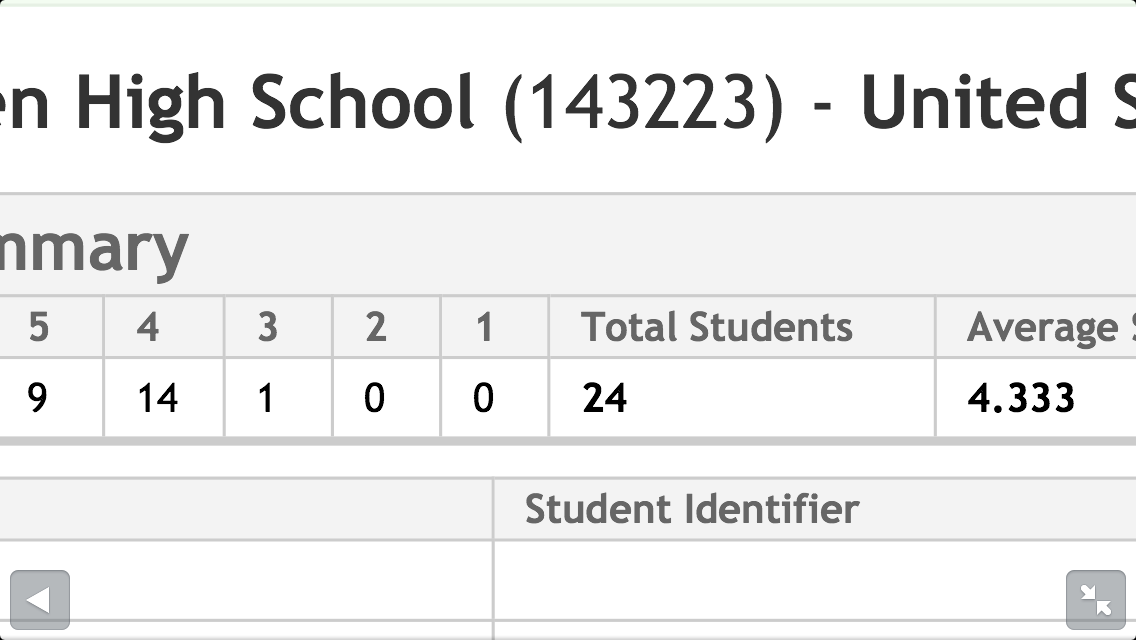
Today my students received their AP US History scores from the college board. Our class average was a 4.33 on the toughest exam the AP offers. Every student in my class took the test and every student is getting college credit for passing it. Finally we may have figured out what George W. Bush meant by, "No Child Left Behind..." I digress. Obviously we are excited and we are proud that our kids got the scores they truly deserved. I've been humbled by it all and refuse to accept the fact that I am a great historian or teacher because of these scores. I work around great minds and educators that intimidate me with how good they are in the classroom. So what is it then? How do you build a culture of success? I guess I am left with these 3 things...

1. Your classroom culture determines motivation- and a motivated student can do anything. 


How do you get kids to do what you want them to do? Scare 'em? You could discipline them. Maybe hold a grade over their head as motivation. Or, you could build a culture where success is the only option. Exactly how we do that is a bit puzzling to me, and articulating it also can be troublesome- all of which probably means that I will be a lousy administrator someday. But creating a positive and successful culture is not a magic potion that you can hand to a teacher or school leader and say, "drink this." Our culture we build in our classroom is just "how we roll." 

But what we can do as administrators and educators is this-  
*We can be relentless with our expectations. We work in a business that raises the bar, not lowers it. Have faith and believe that people can surpass your expectations. We aren't supposed to stack up with some of the best students in the nation. But we do, because we expect to. 

*We can be real with each other. Being honest with our coworkers and with our students makes us real. I tell my students when I'm having a bad day. They do the same. We celebrate each others' accomplishments and build a culture of understanding and compassion for each other. We are unfailing in our support for each other. Once someone knows you care about them, they just seem to care a little more about you.

*We can be consistent. If there is a trait that is more desirable in education,  I guess I haven't found it yet. Ya know, it must be nice to Yankees or Patriots fan because they are just consistently good every year. But students should expect us to be on point. They deserve our energy and our consistent effort. They begin to model those same habits in their work. Their work is a reflection of our preparation and our consistency. 

* And finally, we can run through a wall for each other. This is our class motto. I won't say no to you and you won't say no to me. I will stay after school to help you and you will stay after school to get help. You will email me your questions at 10 p.m. and I will respond. Like any good team, we trust in the guy next to us to do their job. I want the students to succeed. And they want me to be able to write this blog in July bragging about their success. 


2. Success works vertically and horizontally.

We don't teach in a vacuum.  My students are more prepared for success on these standardized tests than ever before because they are getting incredible instruction as freshmen and sophomores and building skills that they will need to be successful at our level. The more time we spend collaborating and scaffolding vertically with other teachers, the better odds for successful student outcomes. 
As the common core ascends upon us, its vital to keep working in interdisciplinary teams too. Horizontal collaboration with my fellow English colleagues has been a foundational part of our success. Kids are getting the same instruction, using the same terminology, and realizing that we have the same expectations across our classes. That could mean a little more work and a little more flexibility for us as teachers, but we are clearly realizing the benefits. The proof is in the pudding. 


3. Professional Development works

School districts and teachers have to support and engage in professional development. Before I started teaching this class, I engaged in the following professional development activities:
1. Two year Literacy Liaison training
2. Two year Technology Liaison training
3. OAH, NCSS, AHA, and AP conferences around the country
4. 1 on 1 course work and countless phone calls with my mentor who had taught the class before
5. American Dreams History Grant
6. Bureau of Education Seminars
7. George Couros' Connected Educator Seminar
8. Google Training

If school districts want successful programs, they have to provide professional development opportunities for their staff. I've improved at my craft because of the opportunities I've been afforded by my district and my boss. There has to be trickle down affect to my students, because I've sort of run out of explanations for all this. I guess that is just how we roll. 


http://www.wordle.net/show/wrdl/6879909/Culture_of_Success


Wednesday, July 3, 2013

Because it's 4th of July...

1. With freedom comes great sacrifice. 
April's chilling events at the Boston Marathon reminded all of us of the consequences to the freedoms we enjoy in this great country. Tomorrow is the 4th of July and we will celebrate our nations 237th birthday. America was founded on principles of freedom, opportunity, and eventually, equality for all persons. The suspects in the Boston Bombing were allowed to enter this country and had the opportunity to build decent lives for themselves. They were aided by over $100,000 of government assistance through public housing and food stamps. They used internet, cell phones and email. They traveled, went to school, and hung out with friends. These daily tasks involve basic liberties that we take for granted. And while it may have been these very liberties that allowed the Tsarnaev brothers to plan and execute the bombing, we cannot overlook how sacred our freedoms truly are. 4th of July is an opportunity to reflect on how lucky we are to have these freedoms.


2. Our political bias probably doesn't belong in the classroom.

Recently, I participated in the American Dreams Project that pulled together 15 educators from seven different suburban schools. For three weeks, we read new scholarly works in history, debated their uses in the classroom, and created ready-made lessons to share and implement next school year. We discussed how different authors speak with a bias and how we present this information to students. Most teachers agree that they tend to leave their own political thoughts aside when presenting history. Yet, we all make difficult decisions on text sets and primary sources to present the content. Unfortunately, some teachers inject their own political agendas on their very impressionable students. I think as professionals its important that we try to avoid any bias in our presentation and allow our students to do their own thinking. Using sources from both sides of the political spectrum is fair to our students and helps to create an environment of inquiry. This process is and always will be more important that our "agendas."


3. Be thankful for what you do have, and you will end up having more. If you concentrate on what you don't have, you will never have enough. 

I think this phrase is both timely and appropriate for educators in the 21st century. Our job descriptions are constantly changing, our students are changing, our instruction is changing, and our profession is changing. I think its easy to want more out of our profession. New teachers want to teach better classes. Veteran teachers want a better schedule. All teachers want the best students and parents. Aspiring administrators want that big job promotion. Administrators want more faculty buy-in. This profession has seen its share of perks taken away at national, state, and district levels- which naturally leaves us all wanting more. But if our focus is always on wanting something we don't have or lamenting what we used to have, we will all be living unfulfilled careers. If we shift our focus to the positive- if we stop to think about the alternatives- if we truly believe we are exactly in the right place, eventually, we will end up having more. That's preachy, but I think it gives us purpose.

Tuesday, February 19, 2013

Cheeky Grins


1. The gap between high school curriculum and post-secondary education is as wide as ever.

Well, according to Dartmouth University among other high institutions of learning. You know that I’m still fired up about this if I am talking about a story that made its waves in January. But the truth is, “Dartmouth’s Last Stand” against the College Board and AP tests is just the tip of the iceberg in this story. http://thedartmouth.com/2013/02/13/news/ap 

Dartmouth’s policy of no longer accepting AP scores as credit for college courses beginning in 2014 is beyond dumbfounding. Dartmouth statistics show that just 10% of students who pass these tests could pass the school’s placement exams. So that must mean Dartmouth’s curriculum is just that more comprehensive and avant-garde than what we do in high schools, right?

Wrong.

What most American high schools are doing to prepare kids for college and the real world is way more progressive that what our universities are doing. Work programs, co-ops, internships, and business partnerships formed by our high schools have given kids more opportunities than ever to advance their career before they are even old enough to watch an R-rated movie. Teachers that have worked within the structure of the College Board curriculum have not only given their college bound students a chance to be successful in passing these tests, but have made the curriculum relevant to their lives. So you tell me what is more progressive: A policy that suppresses student achievement  in high school in favor of collecting more tuition dollars, OR, a curriculum that is comprehensive enough to value achievement, encourage career paths, and motivate students to choose a job they will enjoy the rest of their lives…


2. No matter how spontaneous you are, structure is still important.

A while back, I wrote about how the model of classroom management established in Harry Wong’s, The First Days of School, was somewhat archaic and maybe even a regressive method for teaching a class. I am an educator who values creativity and capturing student attention because it helps my students learn more. I believe that.

But sometimes, structure is necessary, even with the smallest of things.

I am an ardent supporter of having my students stand and say the pledge of allegiance every day before 2nd period begins. From a legal perspective, I suppose they don’t have to- per their first amendment rights. But coming from a family with many veterans, I think it’s the least we can do to honor our country every day. I guess that is part of my not-so, “hidden curriculum.”

It took me 31 class days to figure it out, but today I realized my class was no longer saying the pledge. I was the only one belting it out this morning. My students were standing, half of them had their hands over their hearts, but I was literally talking to “Old Glory” by myself.

Then I realized that I never established that as a routine and a priority during the first few days of class this semester, and now I am paying the price. Harry Wong was right. The first few days of school are really, really important to your class functioning the way you want it to.


 3.       Don’t judge a book by its cover.

I’ll admit to falling prey to the occasional reality TV show my wife imposes on me. The Susan Boyle(a must watch video above) story on "Britain's Got Talent," eventually led us to watch "American Idol" and "The Voice." Although I remain steadfastly committed to anything that's on TV in the man-cave when the "Real Housewives" or "The Bachelorette" walk into my family room, I do find the signing competitions entertaining.

Not to sound holier than thou, but the Susan Boyle story is a constant reminder of this important message. Don't judge a book by its cover. Whether its administrators questioning a staff member, teachers judging a student, or educators who just over-value first impressions...there's a lot more to Susan Boyle than that "cheeky grin."